
United Kingdom
A four-nation state with a global financial centre, major universities and research institutions, advanced industries, a large service economy, extensive cultural influence and a strategically important North Atlantic position.
United Kingdom at a Glance
Four nations, a global economy & a deep research ecosystem
The United Kingdom comprises England, Scotland, Wales and Northern Ireland. Its geography spans the Atlantic, North Sea, Irish Sea and English Channel, creating a distinctive relationship between ports, cities, energy systems, maritime research and international trade.
London is the principal financial and international business centre, while Manchester, Birmingham, Edinburgh, Glasgow, Bristol, Leeds, Liverpool, Cardiff, Belfast, Cambridge and Oxford form important regional centres for industry, science, education, culture and innovation.
The economy combines services with advanced manufacturing, aerospace, automotive, pharmaceuticals, life sciences, creative industries, energy, food systems and internationally traded professional services.
United Kingdom in Europe
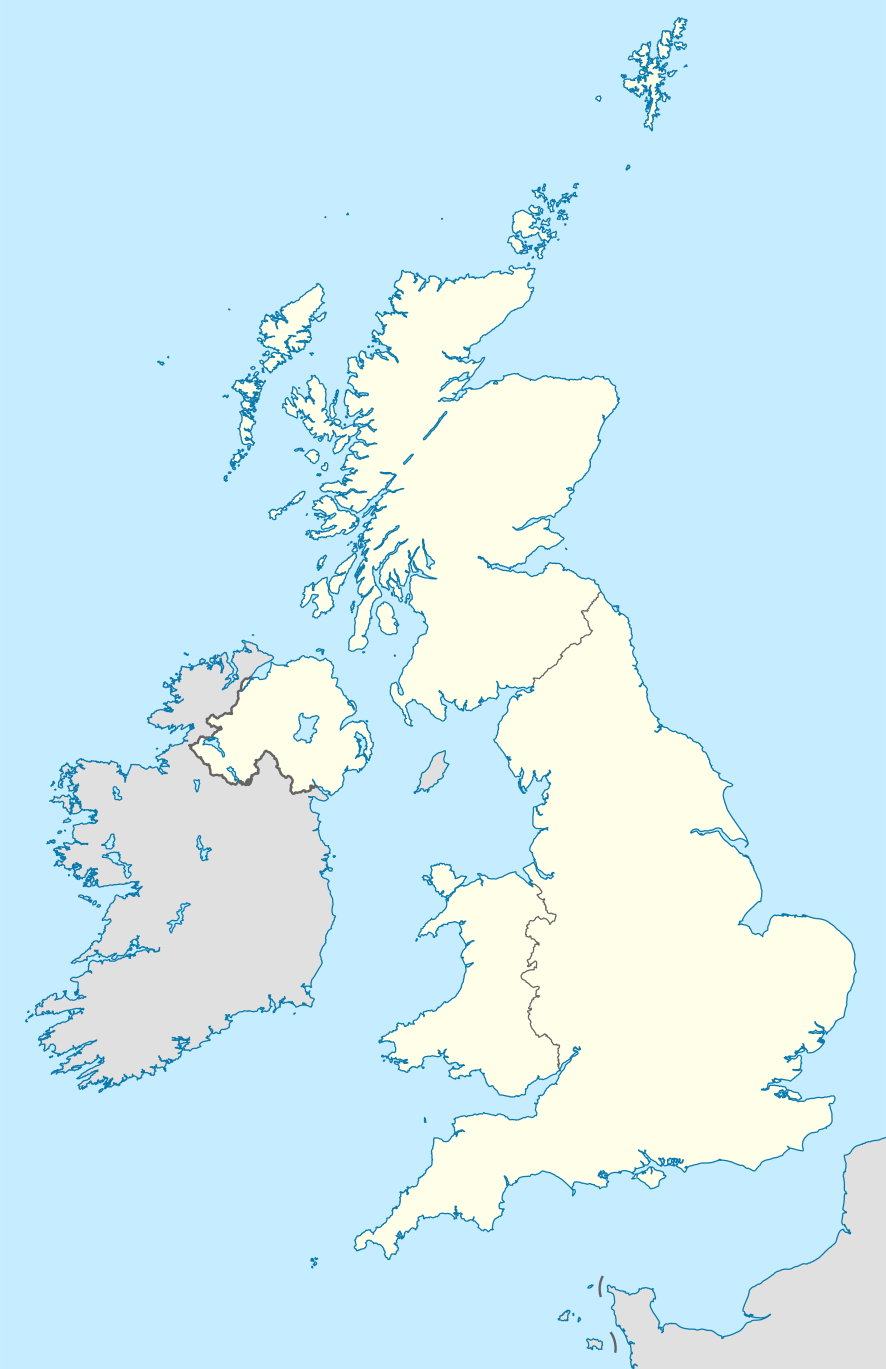
The UK is an island state on Europe's north-western Atlantic margin. The map covers the United Kingdom's geographic extent from northern Scotland to southern England.
United Kingdom Country Research Agenda
Finance & Financial Services
Banking, insurance, capital markets, investment management, fintech and financial regulation centred strongly on London.
Science & Research
Fundamental science, engineering, medicine, biotechnology, climate science and research-intensive universities.
Technology & AI
Artificial intelligence, software, cybersecurity, semiconductors, quantum technologies and digital public services.
Aerospace & Advanced Manufacturing
Aircraft, engines, automotive systems, precision engineering, robotics and industrial research.
Life Sciences & Medicine
Pharmaceuticals, biotechnology, medical research, clinical science and health innovation.
Energy & Climate
Offshore wind, nuclear power, grid infrastructure, energy storage and decarbonisation.
Maritime & Ocean Research
Ports, shipping, marine ecosystems, North Sea energy, coastal resilience and ocean science.
Education & Skills
Universities, schools, apprenticeships, STEM skills, vocational education and lifelong learning.
Culture, Society & Heritage
Literature, arts, media, religion, migration, identity, sport and historic environments.
Andy Burnham & the United Kingdom's Government
Andy Burnham
The official GOV.UK Prime Minister page identifies Andy Burnham as the current Prime Minister of the United Kingdom. It states that he became Prime Minister on 20 July 2026.
The UK is a constitutional monarchy and parliamentary democracy. The Prime Minister leads His Majesty's Government. Parliament consists of the House of Commons and House of Lords, while Scotland, Wales and Northern Ireland have devolved institutions with different legislative and administrative responsibilities.
This section is presented descriptively, focusing on constitutional structure, public administration and documented office-holding rather than political evaluation.
GOV.UK · Prime Minister →England · Scotland · Wales · Northern Ireland
The United Kingdom's territorial and constitutional system combines UK-wide institutions with devolved government in Scotland, Wales and Northern Ireland.
Research into the Union therefore involves constitutional law, public finance, regional development, infrastructure, identity, public services and intergovernmental relations.
GOV.UK · Minister for the Union →A Diversified Economy with a Global Services Core
Current macroeconomic indicators
ONS reports a UK employment rate of 75.1% for people aged 16–64 in May–July 2026 and an unemployment rate of 4.9% for people aged 16 and over. CPIH inflation was 3.1% in July 2026, while real GDP increased 0.4% quarter-on-quarter in April–June 2026.
London and the wider economic system
London functions as a major international centre for banking, insurance, capital markets, legal services, consulting, media and technology. Outside London, the UK has major industrial, logistics, digital and professional-service clusters distributed across its nations and regions.
Manchester and the North West combine digital industries, advanced manufacturing, health research and transport. Birmingham and the wider Midlands have strong engineering, automotive and logistics capabilities. Edinburgh and Glasgow contribute finance, technology, universities and life sciences, while Cardiff and Belfast anchor important regional research and service economies.
UK economic connectivity
A Major Research and Innovation System
Research intensity
ONS reports that UK R&D expenditure performed in the country reached £79.4 billion in 2024, equivalent to 2.71% of GDP. Business performed £55.6 billion, or 70% of the total, while higher education performed £17.9 billion, or 23%.
Research strengths
The UK research landscape includes major activity in physics, engineering, medicine, biotechnology, artificial intelligence, mathematics, climate science, astronomy, social science and the humanities. Research universities interact with public laboratories, hospitals, businesses and technology organisations.
TEDRIC research can examine how scientific excellence connects to industrial policy, commercialisation, regional development, workforce skills and international research collaboration.
Human Development, NHS Systems & Skills
Healthcare research
The National Health Service operates through distinct systems in England, Scotland, Wales and Northern Ireland. Their organisation and policy frameworks differ, creating a substantial comparative research field in public health, primary care, hospital systems, digital health, medical research and health inequalities.
Population ageing, chronic disease, mental health, workforce planning, medical technologies and prevention are central areas for health research.
Education & skills
The UK hosts a large higher-education sector and internationally connected research universities. Education research spans school systems, higher education, vocational education, apprenticeships, STEM, teacher supply, lifelong learning and regional skills gaps.
London, Oxford, Cambridge, Edinburgh, Glasgow, Manchester, Birmingham, Bristol, Leeds, Cardiff and Belfast are among the important nodes in the wider knowledge and innovation system.
England, Scotland, Wales & Northern Ireland
England
Largest population and economic base, with London, the Midlands, North West, North East, South West and South East forming diverse regional economies.
Scotland
Edinburgh and Glasgow anchor finance, education, research and culture, alongside energy, food, tourism and maritime sectors.
Wales
Distinctive language and cultural heritage, with research and economic activity in Cardiff, Swansea, North Wales and regional communities.
Northern Ireland
Belfast is a major centre for technology, advanced manufacturing, higher education and services, with strong cross-Irish Sea and cross-border connections.
Devolution
Scotland, Wales and Northern Ireland have devolved institutions with different powers and legislative responsibilities.
Regional Research
TEDRIC can compare productivity, infrastructure, education, health, innovation and demographic change across the four nations.
London, England, Scotland, Wales & Northern Ireland


A Long Historical Perspective
Early Landscapes
Neolithic monuments, prehistoric settlements and long-lived regional cultures form an important archaeological record.
Kingdoms & Unions
England, Scotland, Wales and Ireland developed through complex political, linguistic and cultural histories.
Acts of Union
The political union of England and Scotland in 1707 and later arrangements reshaped the British state.
Industrial Revolution
Industrialisation transformed manufacturing, cities, transport, science, trade and global economic relationships.
Modern United Kingdom
Post-war reconstruction, decolonisation, European integration and later devolution shaped the contemporary state.
A Multi-Centred Research Geography
Global Capital
- Finance & capital markets
- Technology & creative industries
- Universities & international institutions
Research & Science
- Fundamental science
- Medicine & life sciences
- Research-intensive universities
Engineering & Industry
- Automotive & aerospace
- Advanced manufacturing
- Logistics & supply chains
Urban Innovation
- Manchester technology
- Health & life sciences
- Media, culture & advanced industry
Energy & Knowledge
- Renewables & North Sea
- Finance & universities
- Food, tourism & life sciences
Regional Systems
- Cardiff & Belfast research
- Advanced manufacturing
- Regional development & connectivity
United Kingdom: Key Research Priorities
Understanding productivity differences, infrastructure investment, regional innovation and balanced economic development.
Offshore wind, nuclear, grid expansion, storage, industrial decarbonisation and energy affordability.
Population ageing, health inequalities, NHS workforce, prevention, digital health and medical innovation.
Connecting university research with industrial R&D, investment, technology transfer and new enterprises.
STEM education, apprenticeships, higher education, workforce transitions and lifelong learning.
Rail, ports, housing, digital infrastructure, aviation and resilient regional transport systems.
Comparative research on governance, public finance, regional institutions and relationships among the four nations.
Flooding, sea-level rise, biodiversity, land use, agriculture and resilient coastal communities.
United Kingdom Research Directory
Finance & Business
Financial services, investment, insurance, productivity and global trade.
Science & Technology
AI, quantum, physics, engineering, biotechnology and research systems.
Healthcare & Medicine
NHS systems, medical research, ageing, public health and health technology.
Energy & Climate
Offshore wind, nuclear, grid systems, climate adaptation and decarbonisation.
Education & Skills
Schools, universities, STEM, apprenticeships and lifelong learning.
Culture & Society
History, literature, arts, religion, migration, media and sport.
Statistics in this profile are labelled with their reference period. The GDP, labour-market and inflation figures are official ONS measures and should be interpreted within their stated time windows. Political and institutional information is presented descriptively from official government sources.