


Asian Culture
The culture of Asia encompasses the collective and diverse customs and traditions of art, architecture, music, literature, lifestyle, philosophy, food, politics and religion that have been practiced and maintained by the numerous ethnic groups of the continent of Asia since prehistory. Identification of a specific culture of Asia or universal elements among the colossal diversity that has emanated from multiple cultural spheres and three of the four ancient River valley civilizations is complicated. However, the continent is commonly divided into six geographic sub-regions, that are characterized by perceivable commonalities, like culture, religion, language and relative ethnic homogeneity. These regions are Central Asia, East Asia, North Asia, South Asia, Southeast Asia and West Asia.[1]
As the largest, most populous continent and rich in resources, Asia is home to several of the world's oldest civilizations, that produced the majority of the great religious systems, the oldest known recorded myths and codices on ethics and morality.[2][3]
However, Asia's enormous size separates the various civilizations by great distances and hostile environments, such as deserts and mountain ranges. Yet by challenging and overcoming these distances, trade and commerce gradually developed a truly universal, Pan-Asian character. Inter-regional trade was the driving and cohesive force, by which cultural elements and ideas spread to the various sub-regions, via the vast road network and the many sea routes.[4]
Multiple cultural regions
Asia's various modern cultural and religious spheres correspond roughly with the principal centers of civilization.
West Asia (or Southwest Asia as Ian Morrison puts it, or sometimes referred to as the Middle East) has their cultural roots in the pioneering civilizations of the Fertile Crescent and Mesopotamia, spawning the Persian, Arab, Ottoman empires, as well as the Abrahamic religions of Judaism and later Islam.[5] According to Morrison, in his book Why the West Rules--For Now, these original civilizations of the Hilly Flanks are so far (by archaeological evidence) the oldest (first evidence of farming c9000 BC). The Hilly flanksis also the birthplace of his definition of the west (which groups the Middle East with Europe). According to his definition this would make Asia the origin of western culture.[6] Not everybody agrees with him though.
South Asia, India and the Indosphere emanate from the Indus Valley civilisation.[7]
The East Asian cultural sphere developed from the Yellow River civilization.[8] Southeast Asia's migration waves of more varied ethnic groups are relatively recent. Commercial interaction with South Asia eventually lead to the adoption of culture from India and China (including Hinduism, Buddhism, Confucianism, Daoism). The region later absorbed influences from Islam as well, and the Malays are currently the largest Islamic population in the world.[9][10] North Asia's (otherwise known as Siberia) harsh climate and unfavorable soil proved to be unsuited to permanently support large urban settlements and only permits the presence of a pastoral and nomadic population, spread over large areas. Nonetheless, North Asian religious and spiritual traditions eventually diffused into more comprehensive systems such as Tibetan Buddhism that developed its own unique characteristics (e.g. Mongolian Buddhism). For these reasons it is becoming more unconventional to separate it from the rest of East Asian cultures.[11]
Central Asia has also absorbed influences from both West Asia and East Asia (including Persia and Mongolia), making it another melting pot of cultures. The cultural spheres are not mutually disjoint and can even overlap, representing the innate diversity and syncretism of human cultures and historical influences.
He term East Asian cultural sphere defines the common cultural sphere of China, Japan, North Korea, South Korea in East Asia and Vietnam in Southeast Asia.[12] Ethnic and linguistic similarities, shared artistic traditions, written language and moral values suggest that most East Asian people are descendants of the Yellow River civilization, that emerged in the flood plains of northern China around 10.000 years B.P.[13][14] People within this sphere are sometimes referred to as East Eurasian, and the major languages of this region (including Sino-Tibetan, Austroasiatic, Altaic, Austronesian, Kra-Dai) are thought to have originated from regions in China (see East Asian cultural sphere#historical linguistics).
Historically, China occupied the prominent, central role in East Asia for a long time in recorded history, as it "deeply influenced the culture of the peripheral countries and also drew them into a "China-centered" [...] international order", that was briefly interrupted by the 20th century. Nations within its orbit from Central Asia to Southeast Asia paid to the Chinese tributary system (also see List of tributaries of China). The Imperial Chinese Tributary System is based on the Confucian religious and philosophical idea of submission to celestial harmony was also recognized by nations beyond, in Southeast Asia in particular. Ceremonies were presided over by the Emperor of China as the Son of Heaven and curator of the Mandate of Heaven.[15][16] In elaborate ceremonies both, the tributary state and the various Chinese dynasties agreed to mutually favorable economic co-operation and beneficial security policies.[17][18]
Some of defining East Asian cultural characteristics are the Chinese language and traditional writings systems of Hanzi as well as shared religious and ethical ideas, that are represented by the Three teachings Buddhism, Taoism and Confucianism.[19][20][21][22][23] The Chinese script is one of the oldest continuously used writing systems in the world, and has been a major unifying force and medium for conveying Chinese culture in East Asia. Classical Chinese was the literary language of elites and bureaucrats. Historically used throughout the region, it is still in use by Chinese diaspora communities around the world, as well as in Japan, Korea, Vietnam, and pockets of Southeast Asia.[24][25]
However, as Chinese writing concepts were passed on to Korea, Japan and Vietnam, these nations developed their own characteristic writing systems to complement Hanzi. Vietnam invented their own Chữ Nôm glyphs, Japan invented Kana, and Korea invented their own alphabet Hangul. To this day, Vietnam mostly writes in Chữ Quốc ngữ (a modified Latin alphabet) but there is also a resurgence of Hán-Nôm (a type of writing that combines both Chữ Hán and Chữ Nôm) as well. Sino cognates compose a vast majority of the vocabulary of these languages (see Sino-Vietnamese vocabulary, Sino-Korean vocabulary, Sino-Japanese vocabulary). In the 20th century, China has also re-borrowed terms from Japan to represent western concepts known as Wasei-kango.[26]
Apart from the unifying influence of Confucianism, Taoism, Chinese characters and numerous other Chinese cultural influences, East Asian national customs, architecture, literature, cuisines, traditional music, performing arts and crafts also have developed from many independent and local concepts, they have grown and diversified as many rank among the most refined expressions of aesthetic, artistic and philosophical ideas in the world. Notable among others are Japanese gardens and landscape planning, Heian literature, Vietnamese Water puppetry and the artifacts of the Đông Sơn culture.[27][28][29][30] Modern research has also focused on the several nations pivotal role on the collective body of East Asian Buddhism and the Korean influence on Japanese culture as well as Japanese influence on Korean culture.[31][32][33][34]
Southeast Asia
See also: Southeast Asia § Culture
Southeast Asia divides into Mainland Southeast Asia, that encompasses Vietnam, Laos, Cambodia, Thailand, Myanmar and West Malaysia, and Maritime Southeast Asia, that includes Indonesia, East Malaysia, Singapore, the Philippines, East Timor, Brunei, Cocos (Keeling) Islands, and Christmas Island.[35][36] At the crossroads of the Indian and East Asian maritime trade routes since around 500 B.C., the region has been greatly influenced by the culture of India and China. Most of the influence of India came in the era of the Chola dynasty spreading Tamil and Hindu cultures across present south east Asian countries and even expanding and establishing Hindu kingdoms in the region.
The term Indianised Kingdoms is a designation for numerous Southeast Asian political units, that had to a varying degree adopted most aspects of India's statecraft, administration, art, epigraphy, writing and architecture. The religions Hinduism, Buddhism and Islam gradually diffused into local cosmology. Nonetheless, the Southeast Asian nations have very diversely adapted to these cultural stimuli and evolved their distinct sophisticated expression in lifestyle, the visual arts and most notably in architectural accomplishments, such as Angkor Wat in Cambodia and Borobudur in Indonesia.[37][38]
Buddhist culture has a lasting and significant impact in mainland Southeast Asia (Myanmar, Thailand, Laos, Cambodia and Vietnam); most Buddhists in Indochina practice Theravada Buddhism. In the case of Vietnam, it is also influenced much by Confucianism and the culture of China. Myanmar has also been exposed to Indian cultural influences. Before the 14th century, Hinduism and Buddhism were the dominant religions of Southeast Asia.
Thereafter, Islam became dominant in Indonesia, Malaysia and Brunei. Southeast Asia has also had a lot of Western influence due to the lasting legacy of colonialism. One example is the Philippines which has been heavily influenced by the United States and Spain, with Christianity (Catholicism) as the dominant religion. East Timor also demonstrates Portuguese influence through colonialism, as is also a predominantly Christian nation.
A common feature found around the region are stilt houses. These houses are elevated on stilts so that water can easily pass below them in case of a flood. Another shared feature is rice paddy agriculture, which originated in Southeast Asia thousands of years ago. Dance drama is also a very important feature of the culture, utilizing movements of the hands and feet perfected over thousands of years. Furthermore, the arts and literature of Southeast Asia is very distinctive as some have been influenced by Indian (Hindu), Chinese, Buddhist, and Islamic literature.
South Asia
Main articles: Culture of South Asia and Ethnic groups of South Asia
Language families in South Asia
Traditional Rajasthani garments from Jaipur, Rajasthan
Evidence of Neolithic culture has been found throughout the modern states Afghanistan, Bangladesh, Bhutan, Maldives, Nepal, India, Pakistan and Sri Lanka that represent South Asia (also known as the Indian subcontinent). Since 3,300 B.C. in modern-day northeastern Afghanistan, in Pakistan and northwestern India a sophisticated Bronze Age cultural tradition emerged, that after only a few centuries fully flourished in urban centers. Due to the high quality of its arts, crafts, metallurgy and buildings, the accomplishments in urban planning, governance, trade and technology etc. it has been classified as one of the principal Cradles of civilization. Referred to as the Indus Valley civilisation or Harappan Civilisation it thrived for almost 2.000 years until the onset of the Vedic period (c. 1500 – c. 600 B.C.).[39][40]
The great significance of the Vedic texts (that don't mention cities or urban life) for South Asian culture, their impact on family, societal organisation, religion, morale, literature etc. has never been contested. The Indus Valley Civilisation on the other hand has only come to light by means of 20th century archaeology. Scholars, who employ several periodization models argue over whether South Asian tradition is consciously committed to the Harappan culture.[41][42]
Declining climatic conditions, (aridification) and population displacement (Indo-Aryan migration) are regarded as to have caused the fatal disruption of the Harappa culture, that was superseded by the rural Vedic culture.[43][44]
Main articles: Indo-Aryans, Indo-Aryan migrations, and Vedic period
Following the Indo-Aryan settlement in the Indo-Gangetic Plain and the establishment of the characteristic social groups (Brahmanas, Kshatriyas, Vaishyas and Shudras) in the caste system based on the Jāti model in the Varna order, the tribal entities variously consolidated into oligarchic chiefdoms or kingdoms (the 16 Mahajanapadas), beginning in the sixth century B.C. The late Vedic political progress results in urbanization, strict social hierarchy, commercial and military rivalries among the settlers, that have spread all over the entire sub-continent.[45] The large body of Vedic texts and literature, supported by the archaeological sequence allows researchers to reconstruct a rather accurate and detailed image of the Vedic culture and political organisation. The Vedas constitute the oldest work of Sanskrit literature and form the basis of religious, ethic and philosophic ideas in South Asia. They are widely, but not exclusively regarded the basics and scriptural authority on worship, rituals, ceremonies, sacrifices, meditation, philosophy and spiritual knowledge for the future Hindu and Buddhist cosmology. Commentaries and discussions also focus on the development of valid political ideas and concepts of societal progress and ethic conformity.[46]
See also: History of Hinduism § Classical Hinduism (c. 200 BCE-1200 CE)
Hinduism, Buddhism, Jainism and Sikhism are major religions of South Asia. After a long and complex history of cosmological and religious development, adoption and decline, the Hindu-synthesis[47] and the late but thorough introduction of Islam about 80% of modern-day Indians and Nepalis identify as Hindus.[48] In Sri Lanka and Bhutan most people adhere to various forms of Buddhism.[49]Islam is the predominant religion in Afghanistan, the Maldives (99%), Pakistan (96%) and Bangladesh (90%).[50][51][52]
Badshahi Mosque built under the Mughal emperor Aurangzeb in Lahore, Pakistan
Afghanistan and Pakistan are situated at the western periphery of South Asia, where the cultural character has been made by both the Indosphere and Persia.[53] Pakistan is split with its two western regions of Baluchistan and Khyber Pakhtunkhwa sharing a greater Iranicheritage due to the native Pashtuns and Baloch people of the regions. Its two eastern regions of Punjab and Sindh share cultural links to Northwest India. Bangladesh and the Indian state of West Bengal share a common heritage and culture based on the Bengali language. The culture of India is diverse and a complex mixture of many influences. Nepal is culturally linked to both India and Tibet and the varied ethnic groups of the country share many of the festivals and cultural traditions used and celebrated in North and East India and Tibet. Nepali, the dominant language of Nepal uses the Devanagari alphabet which is also used to write many North Indian languages.[54][55]
Bhutan is a culturally linked to Tibet and India. Tibetan Buddhism is the dominant religion in Bhutan and the Tibetan alphabet is used to write Dzongkha, the dominant language of Bhutan. There is a cultural and linguistic divide between North and South India. Sri Lanka is culturally tied to both India and Southeast Asia.[56]Sinhala, the dominant language in the country is written in Sinhala script which is derived from the Kadamba-Pallava alphabet, certain cultural traditions, and aspects of its cuisine, for example, show South Indian influences. Cultural festivals, aspects of its cuisine and Theravada Buddhism, the dominant religion in Sri Lanka, show a Southeast Asian affinity.[57]
Indo-Aryan languages are spoken in Pakistan, Bangladesh, Sinhala of Sri Lanka and most of North, West and East India and Nepal. Dravidian languages namely Telugu, Tamil, Kannada and Malayalam languages are spoken across South India and in Sri Lanka by the Tamil community while Brahui is spoken in Balochistan, Pakistan. Tibeto-Burman languages are spoken in Nepal, Bhutan, North Pakistan and North & North East India. Iranic Languages are spoken in Baluchistan and Khyber Pakhtunkhwa in Pakistan. The main languages of Afghanistan are Pashto and Dari.
Central Asia
Central Asia, in between the Caspian Sea and East Asia, envelops five former Soviet Socialist Republics: Kazakhstan, Kyrgyzstan, Tajikistan, Uzbekistan and Turkmenistan. However, Afghanistan is sometimes included. Its strategic and historic position around the east–west axis and the major trading routes such as the Silk Road has made it a theatre a steady exchange of ideas and east–west conflicts such as the Battle of Talas. The region was conquered and dominated by a variety of cultures, such as the Chinese, Greeks, Mongols, Persians, Tatars, Russians, and Sarmatians. As some Central Asian areas have been inhabited by nomadic people, numerous urban centers have developed in a distinct local character.[58][59]
The Russian Znamensky Cathedral in Tyumen built in 1768
This region was mainly dominated by Russians in the Soviet era and even after its dissolution in 1991. Even now the region is dominated by them.
North Asia
For the most part, North Asia (more widely known as Siberia) is considered to be made up of the Asian part of Russia solely. The geographic region of Siberia was the historical land of the Tatars in the Siberia Khanate. However Russian expansion essentially undermined this and thus today it is under Russian rule. Other ethnic groups that inhabit Siberia include the Buryats, Evenks, and Yakuts. There are roughly 40 million people living in North Asia and the majority consists now of Ethnic Russians. However, many East Asians also inhabit the region, and historically they have been the majority before Russia's expansion east.
West Asia
The Grand Mosque in Kuwait City, one of the largest mosques in the region
West Asia must be distinguished from the Middle East, a more recent Eurocentric term, that also includes parts of Northern Africa.[60] West Asia consists of Turkey, Syria, Georgia, Armenia, Azerbaijan, Iraq, Iran, Lebanon, Jordan, Israel, Palestine, Saudi Arabia, Kuwait, Bahrain, Qatar, United Arab Emirates, Oman and Yemen. Cyprus is frequently considered to be part of the region but it has ethnic and cultural ties to Europe as well. The Israelite/Jewish civilization of the Fertile Crescentwould have a profound impact on the rest of West Asia, giving birth to the 3 Abrahamic faiths. In addition, the Jewish origins of Christianity, along with the many cultural contributions from both Jewsand Arabs in Europe, meant that West Asian culture had left a lasting impact on Western civilization as well. Other indigenous West Asian religions include Zoroastrianism, Yazidism, Alevism, Druze and the Baháʼí Faith.
Today, almost 93% of West Asia's inhabitants are Muslim and is characterized by political Islamic, with the exception of Israel, a Jewish state. At its north-western end, Armenia and Georgia have an unmistakable Christian tradition, while Lebanon shares a large Christian and a large Muslim community. Ethnically, the region is dominated by Arab, Persian, Kurdish, Azerbaijani, and Turkish people. Among them smaller indigenous groups are the Jews, Assyrians, Druze, Samaritans, Yazidis and Mandeans. Many Middle Eastern countries encompass huge deserts where nomadic people live to this day. In great contrast, modern cities like Abu Dhabi, Dubai, Amman, Riyadh, Tel Aviv, Doha and Muscat have developed on the coastal lands of the Mediterranean Sea, the Persian Gulf and at the periphery of the Arabian Desert.[61]
West Asian cuisine is immensely rich and diverse. The literature is also immensely rich with Arabic, Jewish, Persian, and Turkishdominating.
Architecture
The Great Wall of China at Jinshanling
The Taj Mahal, Agra, India
Sun temple at Konarka, Odisha, India
A typical example of Dravidian architecture
Eunpyeong Hanok Village in Seoul, South Korea
Daian-ji temple at Nara, Japan
Borobudur, a Buddhist temple in Indonesia
Ancient ziggurat, Iraq
Asia is home to countless grandiose and iconic historic constructions, usually religious structures, castles and fortifications or palaces. However, after several millennia, many of the greatest buildings have been destroyed or dismantled such as the Ziggurats of Mesopotamia, most of the Great Wall of China, Greek and Hellenistic temples or the royal cities of Persia.[62]
China
Main article: Chinese architecture
Chinese architecture has taken shape in East Asia over many centuries as the structural principles have remained largely unchanged, the main changes being only the decorative details. An important feature in Chinese architecture is its emphasis on articulation and bilateral symmetry, which signifies balance. Bilateral symmetry and the articulation of buildings are found everywhere in China, from palace complexes to humble farmhouses.[63]Since the Tang dynasty, Chinese architecture has had a major influence on the architectural styles of Korea, Vietnam, and Japan.
India
Main article: Architecture of India
See also: Dravidian architecture
Indian architecture is that vast tapestry of production of the Indian Subcontinent that encompasses a multitude of expressions over space and time, transformed by the forces of history considered unique to the sub-continent, sometimes destroying, but most of the time absorbing. The result is an evolving range of architectural production that nonetheless retains a certain amount of continuity across history.[64] Being few architectures brought by Mughals in Northern India. Dravidian architecture in Southern India flourished under chola's, vijayanagara, satavahana and many other south India's flourished kingdoms until the Mughals occupation and followed by Britishers in India.
Korea
Main article: Korean architecture
Korean architecture refers to an architectural style that developed over centuries in Korea. Just like in the case of other Korean arts, architecture tends to be naturalistic, favors simplicity, avoids the extremes and is economical with shapes.
Indonesia
Main article: Architecture of Indonesia
The Indonesian architecture reflects the diversity of cultural, historical and geographicinfluences that have shaped Indonesia as a whole. It ranges from native vernacular architecture, Hindu-Buddhist temples, colonial architecture, to modern architecture.
Indonesian vernacular architecture is called rumah adat. The houses hold social significance in society and demonstrate local ingenuity in their relations to environment and spatial organisation.[65]: 5 Notable examples include Rumah Gadang, Tongkonan, Balinese housesand Javanese Joglo. Hindu-Buddhist temple monument called candi, with the best example are Borobudur massive stone mandala-stupa and Prambanan Hindu temple dedicated to Trimurti gods. By the 16th century, the Portuguese followed by the Dutch colonize Indonesian archipelago, and developed European architecture technique and developed colonial architecture.
Japan
Main article: Japanese architecture
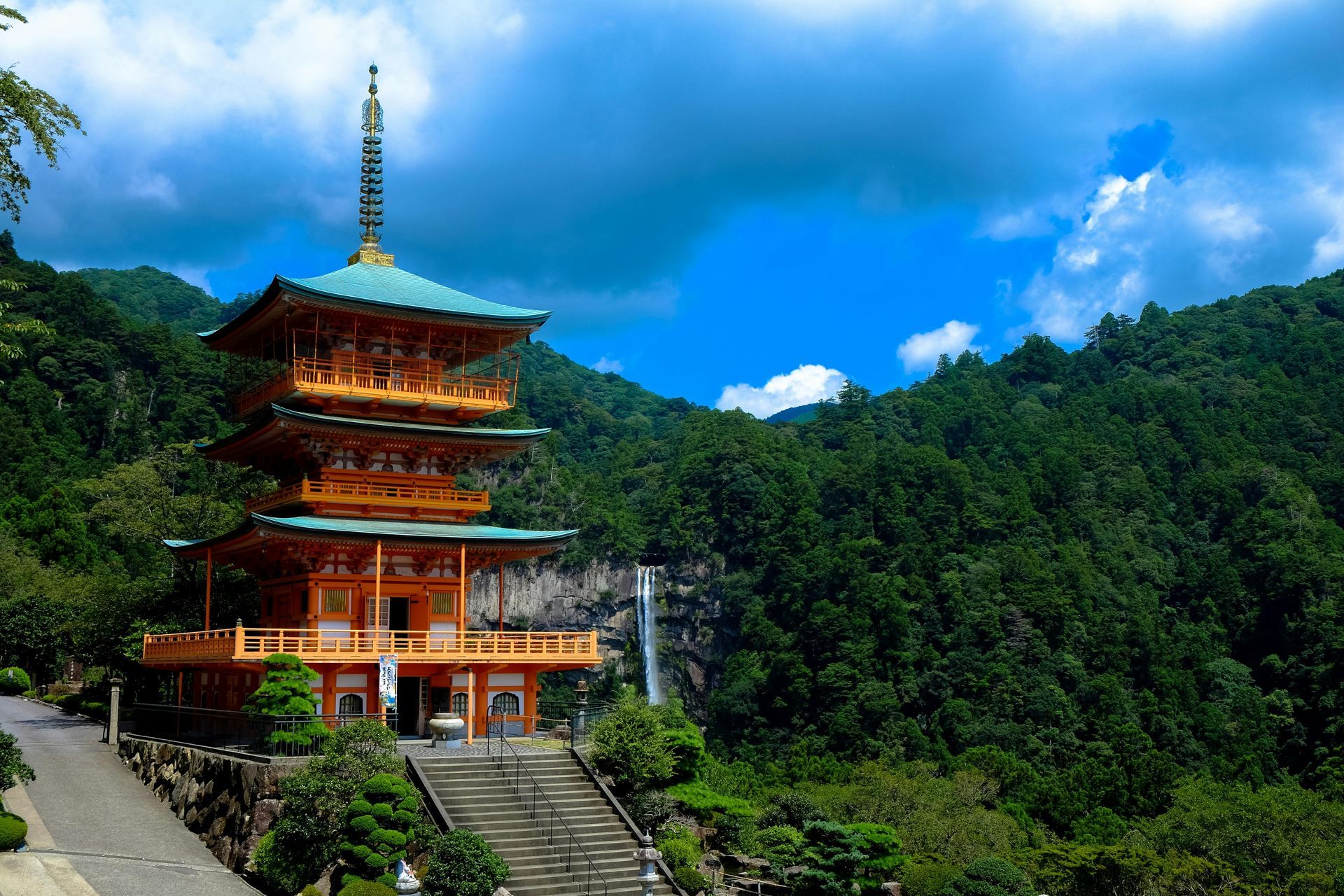
Japanese architecture is distinctive in that it reflects a deep ″understanding of the natural world as a source of spiritual insight and an instructive mirror of human emotion″. Attention to aesthetics and the surroundings is given, natural materials are preferred and artifice is generally being avoided. Impressive wooden castles and temples, some of them 2000 years old, stand embedded in the natural contours of the local topography. Notable examples include the Hōryū Temple complex (6th century), Himeji Castle (14th century), Hikone Castle(17th century) and Osaka Castle.[66]
The architecture of any country is a marker of its culture, history and tradition. The materials used, the shape, the lines, curves and colours all come together to present a masterpiece that is unique and beautiful. Vietnamese architecture is no different. From vernacular stilt houses to extravagant palaces and concrete towers, the country's building is an ode to its rich past and its promising future.
Nepal
Main article: Architecture of Nepal
Vietnam
Main article: Vietnamese architecture
Traditional houses in Vietnam were characterized by wooden structures topped by steep roofs. The roofs would be covered with fish-scale tiles and curve outwards, while beams and rafters held up the main building. In some places, stilt houses were built and the houses usually had an odd number of rooms. However, the coming of various dynasties shaped cultural landmarks in the country in different ways. Palaces, pagodas and citadels flourished in Vietnam for over 500 years.
The Lý dynasty of the 11th century, for example, was deeply influenced by Buddhism and incorporated intricate reliefs and motifs into their architecture. In 1031, a staggering 950 pagodas were constructed by the reigning monarch Lý Thái Tông. During this period, rounded statues, door-steps, decorated roofs and bannisters were common features of Vietnamese architecture. The Imperial Citadel of Thăng Long, a UNESCO world heritage site now, is a must-visit for tourists looking to experience Vietnamese heritage up close. Located in present-day Hanoi, the citadel was the political Centre of the region for 13 centuries consecutively and will delight history buffs in particular. This magnificent structure is a fine example of Vietnamese architecture from the medieval era.
Trần dynasty, which gained a foothold in the 13th century, brought its own set of beliefs and customs that made its mark in Vietnam's architectural history. Buildings became more complex and demarcated, and gardens became a part of temples and places of worship. Tower-temples also emerged at this time; The Phổ Bình Tower in Nam Định province and Bình Sơn Tower in Vĩnh Phúc province are relics from the Trần dynasty.
Malay Peninsula
Main article: Malay architecture
Various cultural influences, notably Chinese, Indian and Europeans, played a major role in forming Malay architecture.[67] Until recent time, wood was the principal material used for all Malay traditional buildings.[68] However, numerous stone structures were also discovered particularly the religious complexes from the time of Srivijaya and ancient isthmian Malay kingdoms.
West Asia
Main articles: History of architecture and Architecture of Mesopotamia
The ancient architecture of the region of the Tigris–Euphrates River system dates back to the 10th millennium BC and lead to the development of urban planning, the courtyard house, and ziggurats.[69] The basic and dominant building material was the mudbrick, which is still in use in the region for the construction of residential structures. Kiln-burnt bricks were coated with a vitreous enamel for purposes of decoration and bitumen functioned as cement. Palaces or temples were constructed on terraces as rooms usually grouped round quadrangles, with large doorways and the roofs rested on richly ornamented columns.[70]